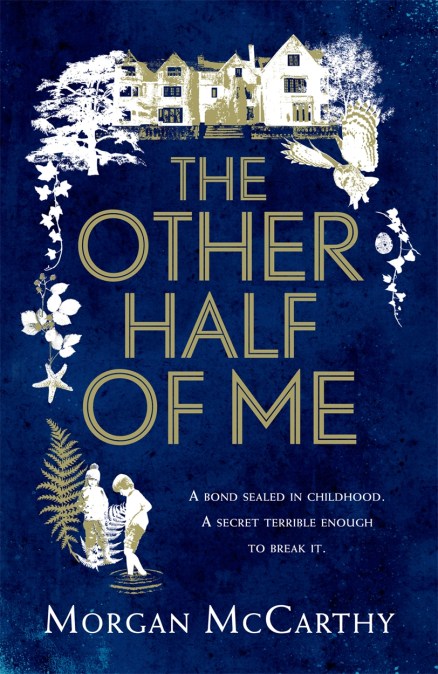
Morgan Mccarthy - The Other Half of Me - Headline
Available Formats
  • Hardback £14.99
    More information
    • ISBN:9780755388738
    • Publication date:24 May 2012
  • Paperback £7.99
    More information
    • ISBN:9780755388752
    • Publication date:25 Oct 2012

The Other Half of Me

By Morgan Mccarthy

  • E-Book
  • £P.O.R.

Beautifully written, evocative, suspensful, and shot through with a delicious thread of menace, THE OTHER HALF OF ME is an incredibly exciting debut for Headline

Jonathan and Theo's childhood is one in which money is abundant but nurture is scarce. With a father who died when they were very young and a mother who starts drinking at lunchtime, the brother and sister are largely left to roam around their sprawling estate in rural Wales, looking after only themselves and each other. Until, that is, their grandmother Eve returns to the family home. Eve is a figure who is as enchanting as she is forbidding, and she takes the children under her wing, answering their questions about their family history that have always been ignored. Yet as they grow older, they discover that much of what they've been told is a fiction, and that something very sinister lies in their past.

  • Other details

  • ISBN: 9780755388769
  • Publication date: 24 May 2012
  • Page count: 270
Biographical Notes

Morgan McCarthy read English at Reading University, where she graduated with First Class honours. In 2008, she started working part-time in order to write her first novel, THE OTHER HALF OF ME.

'Dark, addictive and a stunning debut' — Cosmopolitan
'Gorgeously written' — Heat
'An accomplished novel... McCarthy's exquisite storytelling points to a promising literary career' — Edinburgh Evening News
'Bath-time reading sorted with Morgan McCarthy's pageturner' — Sunday Times
'A beautiful, brooding novel... Darkly lush, filled with an irresistibly sad glamour, this is a memorable debut' — Kirkus
Tinder Press

The Outline of Love

Morgan Mccarthy

Persephone Triebold has grown up in the strange desolation of the Scottish Highlands, raised by her anxious father and memories of her dead mother. Inexperienced in the rules of friendship, sex and love, Persephone takes the opportunity to replace uninhabited mountain ranges with city life and leaves to study for a degree in London.Parties, new friends and the polluted splendour of the capital intoxicate Persephone at first, but fail to supply her with the grand passion she wants. It's only when she meets the literary star Leo Ford, a former singer who has become a celebrated writer, that she finds someone she can love. Though Persephone succeeds in entering Leo's circle of friends she finds him to be as elusive as he is sought after. And she becomes increasingly curious about the incident in his past of which no one ever speaks...

Posted by Morgan McCarthy, Author

Blog: Fitzgerald's THE GREAT GATSBY, and THE OTHER HALF OF ME

The Great Gatsby, F. Scott Fitzgerald's Jazz Age masterpiece, has been one of my favourite novels since I first read it in school. The elegant, spare construction, the exquisite prose and the brutally vivid characters defined for me what writing ought to be, and (while I can only hope to capture them a fraction as well as Fitzgerald) its themes of beauty, longing and loss have had a strong influence on my first novel, The Other Half of Me. When the narrator of The Great Gatsby, Nick Carraway, arrives at Long Island's old-money community of East Egg, he is at first enchanted by this idyll of ease and privilege. His cousin Daisy, her husband Tom and their set drift effortlessly through life, buoyed by wealth and their sense of being rightfully placed at the very apex of society. Gatsby, a newcomer to Long Island, appears to be the most languidly purposeless of all, presiding over his endless, legendary parties. But below the surface Gatsby is lashed on by his own fierce dreams, while East Egg society is underlaid by desperation and violence, glimpsed when Tom breaks his mistress's nose, then finally laid bare with three sudden, bloody deaths. I took inspiration from this while writing my first novel, The Other Half of Me. It begins with its narrator, Jonathan Anthony, looking back on his own his early life with his family at Evendon, their remote, greenly beautiful country estate, which is presided over by his charismatic grandmother Eve. But Jonathan's paradise is seductive and as shaky as Gatsby's, and he finds himself watching as family secrets, drugs, and mental illness threaten this delicately balanced existence. In The Great Gatsby Fitzgerald also meditates on the power of the past. I've never forgotten the novel's painfully lovely, melancholic final line: 'So we beat on, boats against the current, borne back ceaselessly into the past'. Gatsby, after a brief romance, has spent his life dreaming of having Daisy: a longing that becomes all-consuming, expressing his ideas of heaven on earth. As Nick observes, once Gatsby has found Daisy again: 'his dream must have seemed so close he could hardly fail to grasp it. But what he did not know was that it was already behind him, somewhere in the vast obscurity beyond the city.' Similarly, Jonathan's model of himself - his forward-facing ambition - has its roots in his early vision of Eve; the moment she arrived at Evendon with the power to repair his disordered childhood and make everything right. Both Jonathan and Gatsby think they are looking to the future, striving for a happiness they can't truly comprehend, but their dream is actually of something in their past. In both cases, the dream is already over. Gatsby's story ends in death, though Nick Carraway - and Jonathan - get a second chance.

Posted by Leah Woodburn, Editorial

Blog: Staff Hot Picks For 2012

The fairy lights have been packed away, it’s relentlessly gloomy outside, your rail ticket has gone up, there’s still Christmas cheese in the fridge. As months go, January isn’t the best. Perhaps that’s why we spend most of it looking forward – for it’s the month, is it not, where we peer into the year ahead and contemplate what it has in store for us.

Posted by Richard Roper, Editorial

Blog: Musical Mystery Tour

We all have that moment at one time or another when a piece of music comes on in the background and you have to stop what you're doing and just listen. This is a regular occurrence for me on Friday afternoons as fellow Headliner Bríd launches into a rendition of an eighties classic and I stop what I'm doing and wonder why cats are fighting with dentists' drills in the office.

CHAPTER SAMPLER

eBook of Month

Evil will follow you… Wherever you go. Can you find a way to hide? If you like Karen Rose, Katia Lief or Mary Burton you’ll love Debra Webb’s bestselling Faces of Evil series. Click below to read the first chapter of the third instalment, POWER, published for the first time in the UK this month.

POWER by Debra Webb

eBook of the month

Evil will follow you… Wherever you go. Can you find a way to hide? If you like Karen Rose, Katia Lief or Mary Burton you’ll love Debra Webb’s bestselling Faces of Evil series. Click below to read the first chapter of the third instalment, POWER, published for the first time in the UK this month.

Posted by Mary-Anne Harrington, Editorial

Blog: Summer Reads

Though the sun may only now be peeking through the clouds, we at Tinder Press have been counting down to summer, or at least the publication of Maggie O’Farrell’s INSTRUCTIONS FOR HEATWAVE, for many weeks now. But which are the summer reads that have made us the readers we are today – we asked our team to tell us more about the books that spell ‘summer’ to them.

Headline Review

The Butterfly Cabinet

Bernie Mcgill
Maggie speaks of her novels, inspirations, and more

Read an interview with Maggie O'Farrell

1. Was your childhood ambition always to be a writer? If not, what inspired you to start writing? It was. I’ve no idea where the impulse sprang from but I can’t remember life without it. 2. How long have you been writing? I have a very clear memory of struggling with a story when I was about four or five. I asked my mother if she would write it for me and her reply made a huge impression on me. She said, ‘But if I wrote it it would be my story, not yours.’ It was a very astute answer, I think, as it spurred me to try harder. I’ve kept a diary since I was about nine and wrote stories during my teens. At university and in my early twenties I attended poetry classes, where I was taught by Jo Shapcott and then Michael Donaghy. These had a huge effect on my writing, forcing me to economise, to make each word pull its weight. I was 24 when I started writing what would eventually become my first novel, After You’d Gone. 3. What do you enjoy most about writing? I love the solitude and the secrecy of it - as well as the escapism. 4. Which writers do you admire? Dead ones: Charlotte Bronte, RL Stevenson, George Eliot, Edith Wharton, Leo Tolstoy, Anthony Burgess, Charlotte Perkins Gilman, Molly Keane, James Hogg, Angela Carter, Virginia Woolf. Alive ones: Margaret Atwood, Philip Roth, JM Coetzee, Michele Roberts, Ali Smith, Kate Atkinson, David Mitchell, Colum McCann, Peter Carey, Jeanette Winterson, William Boyd. 5. Which authors have influenced your writing the most and why? That’s a hard question. There are too many of them. The simplest answer would be, initially, Charlotte Bronte, Charlotte Perkins Gilman and Albert Camus. I read them in my teens; your skin is at its thinnest then and you are at your most porous. What you read then will affect you for the rest of your life and I fell for Jane Eyre and The Yellow Wallpaper and The Outsider: they changed the way I looked at the world and my concept of what fiction could do. More recently, I’ve been entranced by Margaret Atwood, Virginia Woolf, Tolstoy, Edith Wharton, Angela Carter. If I like a book I might read it several times and with each read you find something different. There are books I will study. I’ve been poring over Mrs Dalloway in the last few months, trying to unpick the prose and the structure, in an attempt to work out how Woolf does it. It’s almost impossible, as it’s so brilliantly and tightly written. 6. What was the last good book you read? I’ve just finished Margaret Atwood’s The Penelopiad, her interpretation of the Odysseus myth. I loved it as it always bothered me that Penelope seemed so uncomplaining and patient in the face of her husband’s extended absence and persistant infidelity. 7. To what extent has your life experience influenced your writing? I don’t use my life in my novels, or not directly. I would never write autobiographically as I tend to write as an alternative to my life, not a repetition or imitation of it. But inevitably there are elements of it that come into my books, in different forms. I think all fiction is a patchwork of things you’ve made up, things you’ve borrowed or heard or read somewhere, and things you’ve translated from life. 8. Do you always know how your books will end before you start writing? No, not at all and that’s part of the pleasure. I have a quote by Picasso beside my desk: ‘If you know exactly what you are going to do, what is the point of doing it?’ I couldn’t imagine anything worse than planning every last detail of a book and then spending the next two or three years working through that plan. I enjoy the way your ideas for a book mutate and alter as you go along. I start – sometimes at the beginning, sometimes in the middle – often without any idea how it will end. And if I do begin with an image for the ending in mind usually by the time I get to the end it’s all changed. 9. What inspired your new novel The Vanishing Act of Esme Lennox? It is a novel I’ve wanted to write for a long time. I first had the idea – of a woman who is incarcerated in an asylum for a lifetime – fifteen years ago. I tried to write it then, as my first novel, but it didn’t work and I ended up abandoning it to write After You’d Gone instead. This was in the mid nineties, after Thatcher’s Care in the Community Act, when psychiatric hospitals were being closed down and patients turfed out. There were a lot of stories flying around at that time of people, particularly women, like Esme who had been put away for reasons of immorality and left to rot. A friend told me about his grandmother’s cousin, who had just died in an asylum, having been put there in her early twenties for “eloping with a legal clerk”. The idea never went away and I gradually amassed more and more stories and examples of girls who had been committed in the early Twentieth century for little more that being disobedient or incalcitrant. When you start to dig a little deeper, into case notes and medical reports, the findings are terrifying. I’ve always been interested in the idea of what happens to the same type of woman – uncompromising, unconventional, refusing to fit into the domestic role society has set out for her – at different times in history. Centuries ago, she might have been condemned as a witch but as recently as sixty years ago she might have been deemed insane and committed to an asylum. 10. How is your new novel different from the previous ones? It feels very different to me, in lots of way. It’s partly historical as most of the book takes place in 1930s Edinburgh and colonial India. I think it’s tighter than the others: there are only three main characters, whereas the others have tended to be more wide-ranging. I did a great deal more research for it, on psychiatric practices and institutions, on life and society in the 1930s.

Maggie speaks of her novels, inspirations, and more

Read an interview with Maggie O'Farrell

1. Was your childhood ambition always to be a writer? If not, what inspired you to start writing? It was. I’ve no idea where the impulse sprang from but I can’t remember life without it. 2. How long have you been writing? I have a very clear memory of struggling with a story when I was about four or five. I asked my mother if she would write it for me and her reply made a huge impression on me. She said, ‘But if I wrote it it would be my story, not yours.’ It was a very astute answer, I think, as it spurred me to try harder. I’ve kept a diary since I was about nine and wrote stories during my teens. At university and in my early twenties I attended poetry classes, where I was taught by Jo Shapcott and then Michael Donaghy. These had a huge effect on my writing, forcing me to economise, to make each word pull its weight. I was 24 when I started writing what would eventually become my first novel, After You’d Gone. 3. What do you enjoy most about writing? I love the solitude and the secrecy of it - as well as the escapism. 4. Which writers do you admire? Dead ones: Charlotte Bronte, RL Stevenson, George Eliot, Edith Wharton, Leo Tolstoy, Anthony Burgess, Charlotte Perkins Gilman, Molly Keane, James Hogg, Angela Carter, Virginia Woolf. Alive ones: Margaret Atwood, Philip Roth, JM Coetzee, Michele Roberts, Ali Smith, Kate Atkinson, David Mitchell, Colum McCann, Peter Carey, Jeanette Winterson, William Boyd. 5. Which authors have influenced your writing the most and why? That’s a hard question. There are too many of them. The simplest answer would be, initially, Charlotte Bronte, Charlotte Perkins Gilman and Albert Camus. I read them in my teens; your skin is at its thinnest then and you are at your most porous. What you read then will affect you for the rest of your life and I fell for Jane Eyre and The Yellow Wallpaper and The Outsider: they changed the way I looked at the world and my concept of what fiction could do. More recently, I’ve been entranced by Margaret Atwood, Virginia Woolf, Tolstoy, Edith Wharton, Angela Carter. If I like a book I might read it several times and with each read you find something different. There are books I will study. I’ve been poring over Mrs Dalloway in the last few months, trying to unpick the prose and the structure, in an attempt to work out how Woolf does it. It’s almost impossible, as it’s so brilliantly and tightly written. 6. What was the last good book you read? I’ve just finished Margaret Atwood’s The Penelopiad, her interpretation of the Odysseus myth. I loved it as it always bothered me that Penelope seemed so uncomplaining and patient in the face of her husband’s extended absence and persistant infidelity. 7. To what extent has your life experience influenced your writing? I don’t use my life in my novels, or not directly. I would never write autobiographically as I tend to write as an alternative to my life, not a repetition or imitation of it. But inevitably there are elements of it that come into my books, in different forms. I think all fiction is a patchwork of things you’ve made up, things you’ve borrowed or heard or read somewhere, and things you’ve translated from life. 8. Do you always know how your books will end before you start writing? No, not at all and that’s part of the pleasure. I have a quote by Picasso beside my desk: ‘If you know exactly what you are going to do, what is the point of doing it?’ I couldn’t imagine anything worse than planning every last detail of a book and then spending the next two or three years working through that plan. I enjoy the way your ideas for a book mutate and alter as you go along. I start – sometimes at the beginning, sometimes in the middle – often without any idea how it will end. And if I do begin with an image for the ending in mind usually by the time I get to the end it’s all changed. 9. What inspired your new novel The Vanishing Act of Esme Lennox? It is a novel I’ve wanted to write for a long time. I first had the idea – of a woman who is incarcerated in an asylum for a lifetime – fifteen years ago. I tried to write it then, as my first novel, but it didn’t work and I ended up abandoning it to write After You’d Gone instead. This was in the mid nineties, after Thatcher’s Care in the Community Act, when psychiatric hospitals were being closed down and patients turfed out. There were a lot of stories flying around at that time of people, particularly women, like Esme who had been put away for reasons of immorality and left to rot. A friend told me about his grandmother’s cousin, who had just died in an asylum, having been put there in her early twenties for “eloping with a legal clerk”. The idea never went away and I gradually amassed more and more stories and examples of girls who had been committed in the early Twentieth century for little more that being disobedient or incalcitrant. When you start to dig a little deeper, into case notes and medical reports, the findings are terrifying. I’ve always been interested in the idea of what happens to the same type of woman – uncompromising, unconventional, refusing to fit into the domestic role society has set out for her – at different times in history. Centuries ago, she might have been condemned as a witch but as recently as sixty years ago she might have been deemed insane and committed to an asylum. 10. How is your new novel different from the previous ones? It feels very different to me, in lots of way. It’s partly historical as most of the book takes place in 1930s Edinburgh and colonial India. I think it’s tighter than the others: there are only three main characters, whereas the others have tended to be more wide-ranging. I did a great deal more research for it, on psychiatric practices and institutions, on life and society in the 1930s.

Her novels, inspirations and more

An interview with Maggie O'Farrell

Click here to read an interview with Maggie O'Farrell, where she talks about her novels, inspirations and more.

Headline Review

The Vanishing Act of Esme Lennox

Maggie O'Farrell

THE VANISHING ACT OF ESME LENNOX is vintage Maggie O'Farrell: a stunning imagining of a life stolen, and reclaimed.Edinburgh in the 1930s. The Lennox family is having trouble with its youngest daughter. Esme is outspoken, unconventional, and repeatedly embarrasses them in polite society. Something will have to be done.Years later, a young woman named Iris Lockhart receives a letter informing her that she has a great-aunt in a psychiatric unit who is about to be released.Iris has never heard of Esme Lennox and the one person who should know more, her grandmother Kitty, seems unable to answer Iris's questions. What could Esme have done to warrant a lifetime in an institution? And how is it possible for a person to be so completely erased from a family's history?

Headline Review

The Proposal

Tasmina Perry
Posted by Imogen Taylor, Editorial

Blog: Location Blues

So, it’s raining, there are flood warnings, and there’s also a drought warning. And people think I’m contrary? Anyway, to cut a long thought short, it’s got me mulling over where I want to be right now, instead of sitting at my desk staring out at a violet and charcoal bulge of cloud looming in from the west, ready to burst over the Euston Rd.

Headline

Sadie was a Lady

Joan Jonker

Beautiful, blonde-haired Sadie Wilson suffers abuse from her slovenly mother and lecherous father in order to protect her younger siblings from a similar fate. The neighbours avoid her parents like the plague and Sadie has no friends to turn to for help. But when Harry, the kind-hearted boy next door, sees Sadie crying because her father has lost all their money, he offers to pay her sixpence for a kiss. With coins in her pocket, Sadie goes to Paddy's market to buy underclothes she so desperately needs and it is there that she meets Mary Ann and a lively bunch of Liverpudlian stallholders who are to be her salvation. Even though she is rescued by Mary Ann's friends and starts a new life, Sadie's thoughts still return to her brothers and sisters back at home. And no matter how many admirers she has, there's a place in her heart for just one lad whose kisses she can't seem to forget...

Headline Review

Then She Found Me

Elinor Lipman

One of Elinor Lipman's funniest and most entertaining novels.Given up for adoption thirty-six years ago, April Epner, now a quiet-living, sensible-jumper-wearing Latin teacher, has never had the slightest desire to be reunited with her biological mother. But, as it turns out, she doesn't have a choice. When Bernice Graverman, the brash, glamorous host of a mildly successful daytime TV talk show, flounces into her life claiming to be her mother, April is horrified: can she and this woman really share the same genes? Worse still, Bernice seems determined to take up her maternal role where she left off. Her first task: to tackle April's non-existent love life

Posted by Leah Woodburn, Editorial

Blog: Announcing Tinder Press!

It is no ordinary day here at Headline Towers, for it is the day that we finally announced the arrival of our new imprint, Tinder Press. It's a hugely exciting endeavour for us, and we can't wait to tell you more about the fantastic books we'll be publishing – do keep an eye out for them here. And, despite the fact that we're not launching till next year, we're already chattering away: do follow us on Twitter @TinderPress, have a peek at our website: www.tinderpress.co.uk/, and, lo! we’re even on Pintrest: pinterest.com/tinderpress/ The stories are coming…

Eternal Romance

A Lady Awakened: Blackshear Family Book 1

Cecilia Grant
Headline

Survival of the Fittest

Jonathan Kellerman

Weaving together the threads of a mystery that lead from a child's murder to a young scientist's suicide, Kellerman draws one of the most chilling, frighteningly realistic portraits of evil you will ever experience.The mentally disabled daughter of a diplomat is killed in cold blood in a deserted corner of the Santa Monica mountains. Her father adamantly denies the possibility of a political motive, which leaves LAPD detective Milo Sturgis and his friend Alex Delaware to pose the question: why? The father is so intent on controlling the investigation that Alex and Milo start to wonder if he wants to find the truth - or keep it buried. After another killing, within days Alex finds himself ensnared in one of the darkest, most menacing cases of his career. Driven to find answers, Alex goes undercover, alone, to expose the smug brutality of a murderous conspiracy and a terrifying contempt for human life.

Headline

Maggie's Market

Dee Williams

It's 1935 and Maggie Ross loves her life amongst the stallholders in Kelvin Market where her husband Tony has a bric-a-brac stall and where she lives, with her young family, above Mr Goldman's bespoke tailors.  But when one fine Spring day her husband disappears into thin air her world collapses.Maggie has no way of knowing where he husband went nor why he left her so suddenly - especially when she's got a new baby on the way.  What she can tell is who her real friends are as she struggles to bring her children up alone.  There's outspoken, golden-hearted Winnie, her fellow stallholder whose cheerful chatter hides a sad past, and cheeky Eve whom she's known since they were girls.  And there's also Inspector Matthews, the policeman sent to investigate her husband's disappearance;a man who, to the Kelvin Market staffholders, is on the wrong side of the law, a man to whom Maggie is increasingly drawn.